
Tasmania’s energy market is smaller than in other states, but electricity and gas prices can still vary widely between providers. If you haven’t reviewed your options recently, you could be paying more than you need to. Regularly comparing available energy plans on the island can help you find a better deal and save on your household bills.
How does Tasmania's energy system work?
The Tasmanian energy market is deregulated, meaning resident can compare and choose their energy suppliers – though the options are more limited than in other states, especially when it comes to gas.
People living on the island can choose between a variety of electricity retailers but have just two options for their gas plans.
These retailers set their own prices and offer various plans with different rates, discounts and incentives. This competition helps keep costs down and gives Tasmanians flexibility to shop around, compare energy plans and switch providers whenever they want.
What if I live on the Bass Strait Islands?
Electricity generation and distribution on King Island and Flinders Island are managed by Hydro Tasmania, while retail services are provided by Momentum Energy, a Hydro Tasmania subsidiary. There is no mains gas available.
Unlike mainland Tasmania, there is only one general usage tariff (Tariff 51) available, which means all electricity use is charged at a higher general usage rate. This tariff is reviewed annually and adjusted in line with mainland Tasmania’s regulated prices, subject to approval by the Tasmanian Economic Regulator.
Types of energy plans
What is the average energy bill in Tasmania?
Tasmania has historically benefitted from lower-than-average electricity prices compared to mainland Australia.
According to our calculations based on the standing offer on the island/in the state, the annual electricity bill for a three-person household consuming around 5,000 kWh is about $1,900 in Tasmania – roughly $158 per month. This is lower than the national average, which sits at approximately $1,994 per year.
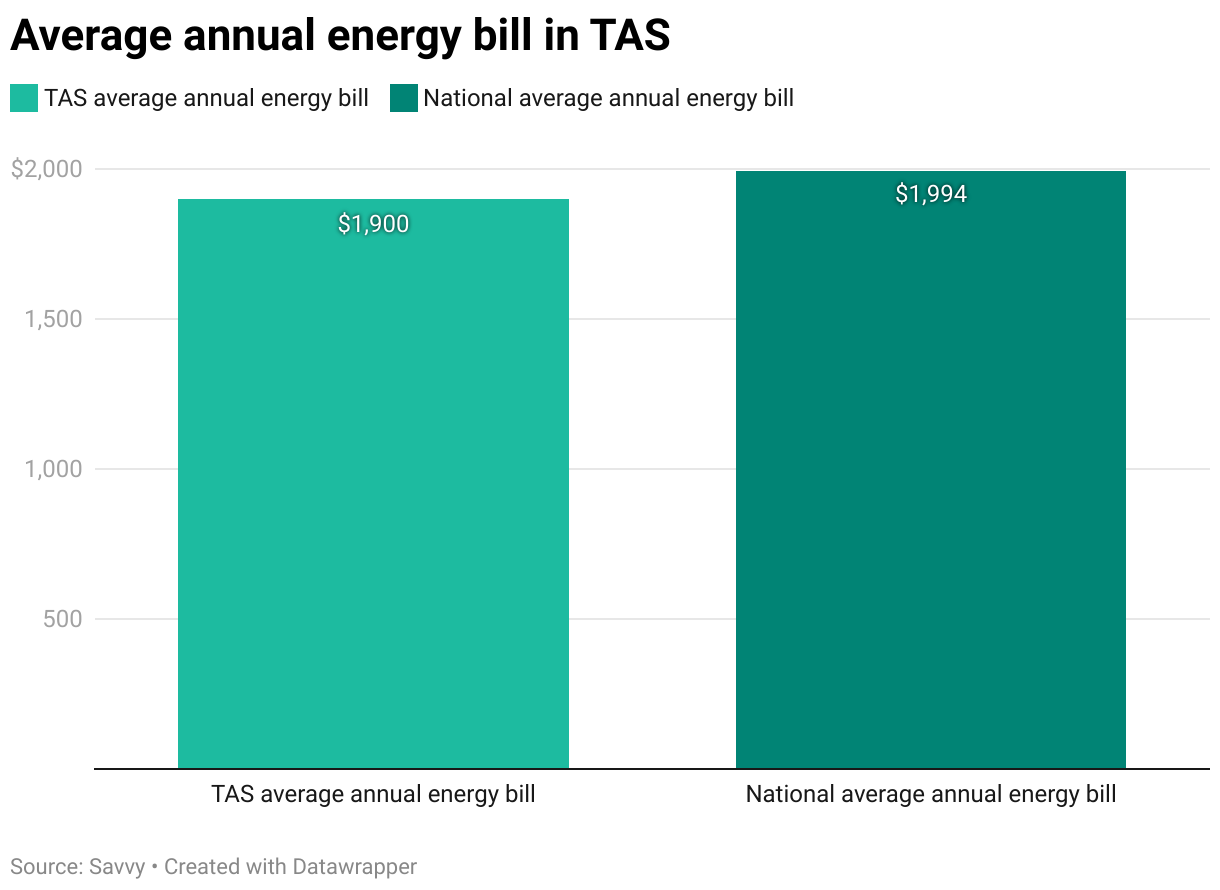
If your bill is higher than this but your household uses less electricity, it could mean you’re on a more expensive plan and there might be better options on the market.
How to compare electricity in Tasmania
How electricity plans work in Tasmania
In Tasmania, there are two types of electricity plans available:
Market offers: these are plans you can choose from any retailer that services your area. Each retailer sets its own prices, discounts and features, so comparing what’s available can help you find a plan that suits your needs and potentially save money.
Standing offer: if you don’t select a plan, you’ll be automatically placed on the standing offer, which is the default, government-regulated price for electricity. In Tasmania, this price is determined by the Tasmanian Economic Regulator. Aurora Energy is the default retailer that supplies all standing offer customers.
Types of electricity tariffs
Your tariff is the pricing structure your electricity plan uses to calculate how much you pay for the electricity you use. Common types of electricity tariffs include:
- Flat (single) rate: you pay the same rate for electricity no matter when you use it.
- Time-of-use: rates change depending on the time of day, with higher prices during peak hours and lower prices during off-peak times.
- Demand tariff: charges are based on your highest electricity use at any one time during the billing period.
- Controlled load: applies to specific appliances, like electric hot water systems, that use electricity on a separate, usually lower-cost rate controlled by your energy provider.
Understanding your tariff helps you know how your electricity costs are determined and can help you choose a plan that suits your usage habits.
What are Tasmania’s standing offer tariffs?
Tasmania’s standing offer plans use specific tariffs to calculate your electricity costs:
- Tariff 93: the default time-of-use tariff for new connections.
- Tariff 62: an off-peak night-only tariff, often used for appliances.
Some older tariffs are still in use by existing customers but no longer available for new connections:
- Tariff 31: a flat-rate tariff for general electricity use (light and power).
- Tariff 41: a flat-rate tariff for hot water and heating.
- Tariff 61: an off-peak controlled load tariff with an overnight period plus a short afternoon boost, usually for high-usage appliances like heaters and hot water systems.
Cheapest electricity plans in Tasmania
These are some of the cheapest electricity plans available in Hobart as of November 2025.
| Retailer | Plan | Estimated monthly cost | Estimated annual cost |
|---|---|---|---|
| Energy Locals | Online Member | $170 | $2,040 |
| Aurora Energy | Residential Flat Rate Contract | $170 | $2,100 |
| Solstice Energy | Standard Residential Single Rate | $180 | $2,210 |
| 1st Energy | 1st Plus – Tariff 31, Residential Light & Power | $190 | $2,250 |
| CovaU Energy | CovaU Basics Residential Anytime | $200 | $2,380 |
| Source: Energy Made Easy, November 2025 Costs based a household on a single rate tariff using 16.4 kWh per day. |
|||
Electricity providers in Tasmania
While TasNetworks is the sole electricity distributor in Tasmania, when it comes to buying your electricity, you have a choice of retailers. These include:
- 1st Energy
- Aurora Energy
- CovaU Energy
- Energy Locals
- Momentum Energy (King Island and Flinders Island only)
- Solstice Energy
Solar power in Tasmania
While Tasmania trails behind some mainland states, by October 2025 nearly a quarter of households on the island had solar panels installed. This growth was boosted by the highly popular Tasmanian Energy Saver Loan Scheme, which offered interest-free loans up to $10,000 to help households invest in energy efficiency upgrades like rooftop solar, insulation and energy-efficient appliances. The scheme provided over 7,500 individual loans before closing early due to high demand.
However, Tasmanians can still benefit from nationwide programs such as the Australian Government’s Small-scale Renewable Energy Scheme (SRES), which helps reduce the cost of new solar installations.
If you already have solar panels, you may earn credits through feed-in tariffs – payments for the surplus electricity you export back to the grid. These rates vary by provider, but as of November 2025, Tasmanian households can receive up to 10 cents per kilowatt-hour.
How to compare gas in Tasmania
How gas plans work in Tasmania
Natural piped gas is mainly available in Tasmania’s major cities and urban areas, including Hobart, Launceston, Devonport, Burnie and Wynyard, serving over 46,000 customers across the state. If you live in these areas, you may be able to choose your gas supplier and plan, though options are limited. There are only two providers in the market, each offering a single gas plan.
Gas providers in Tasmania
Tas Gas Networks is the sole distributor responsible for delivering natural gas throughout Tasmania. The two gas retailers providing services to households in the state are:
- Solstice Energy
- Aurora Energy
Types of gas tariffs
Both Aurora and Solstice offer single-rate gas plans. This means you pay a fixed daily supply charge plus a usage charge based on how much gas you consume. The daily supply charge covers the cost of having gas connected to your home, while the usage charge depends on how much gas you actually use.
Is gas cheap in Tasmania?
No, natural gas prices in Tasmania are among the highest in Australia, due to factors like the state’s small market size and transportation costs.
In 2024, the average annual gas bill for a Tasmanian household using around 30,000 MJ was $1,692 with Solstice Energy and $1,848 with Aurora Energy. This is above the national average gas bill of $1,653, making Tasmania one of the more expensive states for gas, behind only Queensland and South Australia, where average bills are $1,809 and $1,914 respectively. (Queensland’s gas bills are higher than Solstice’s but lower than Aurora’s.)
What if my home uses LPG instead of natural gas?
About 10% of Tasmanian households use LPG (liquefied petroleum gas). Unlike natural gas, LPG is delivered in tanks or bottles and is used in areas without natural gas pipelines.
If your home uses LPG, you can’t compare plans from natural gas providers – instead, you choose from a range of LPG suppliers, each with their own pricing and delivery arrangements.
Why compare energy plans through Savvy?
Tips for comparing energy in Tasmania
-
Know your energy usage
Before you start comparing, check how much energy you use, when you use it and what for. This helps you choose a plan and tariff that match your needs.
-
It’s still worth comparing gas
Even though Tasmania only has two gas retailers, switching to the other provider could still reduce your bills – so it’s worth checking both options.
-
Bundling isn’t always best
Solstice and Aurora offer bundled gas and electricity plans, but make sure you compare electricity deals from all retailers first as there could be cheaper electricity plans elsewhere.
-
Factor in discounts – and the total cost
Sign-up discounts can look appealing, but always check the total cost of the plan. Sometimes a plan with smaller (or no) discounts ends up cheaper overall.
-
Review your plan regularly
The cheapest deal today might not be the cheapest next year. Reviewing your plan annually – and switching if needed – helps keep your costs down.
Energy rebates and concessions in Tasmania
Tasmania offers a range of concessions to help residents manage their energy costs. Although the 2023 Energy Relief Payment that provided eligible Tasmanians with $500 off their electricity bills over two years has now ended, other support options remain available to assist with energy expenses.
Energy Bill Relief Fund
The Australian Government extended the Energy Bill Relief Fund for 2025-26, providing Tasmanian households with $150 in energy bill relief from July 2025 through two $75 discounts applied automatically to bills. However, the program is scheduled to end at the close of 2025.
Energy bill concessions
Eligible households in Tasmania can also access energy concessions that help reduce the cost of their electricity and gas bills throughout the year.