

The Australian Government’s First Home Super Saver (FHSS) scheme helps Australians build their first home deposit faster through super contributions. By putting extra money into your super fund, you can take advantage of both tax savings and higher returns, giving you more money to put towards your first home purchase sooner.
What is the First Home Super Saver scheme?
The FHSS scheme was introduced by the Australian Government in July 2017 to help first-home buyers save for a deposit by using their superannuation. Because money inside super is taxed at a lower rate than regular income, first home buyers can grow their deposit faster than they would in a standard savings account.
Under the scheme, you can withdraw up to $50,000 of voluntary contributions made since 1 July 2017, plus associated earnings, to buy or build your first home. This includes houses, apartments or vacant land if you plan to build a home on it, though properties like houseboats, mobile homes and investment homes aren’t eligible.
How many people use the FHSS scheme?
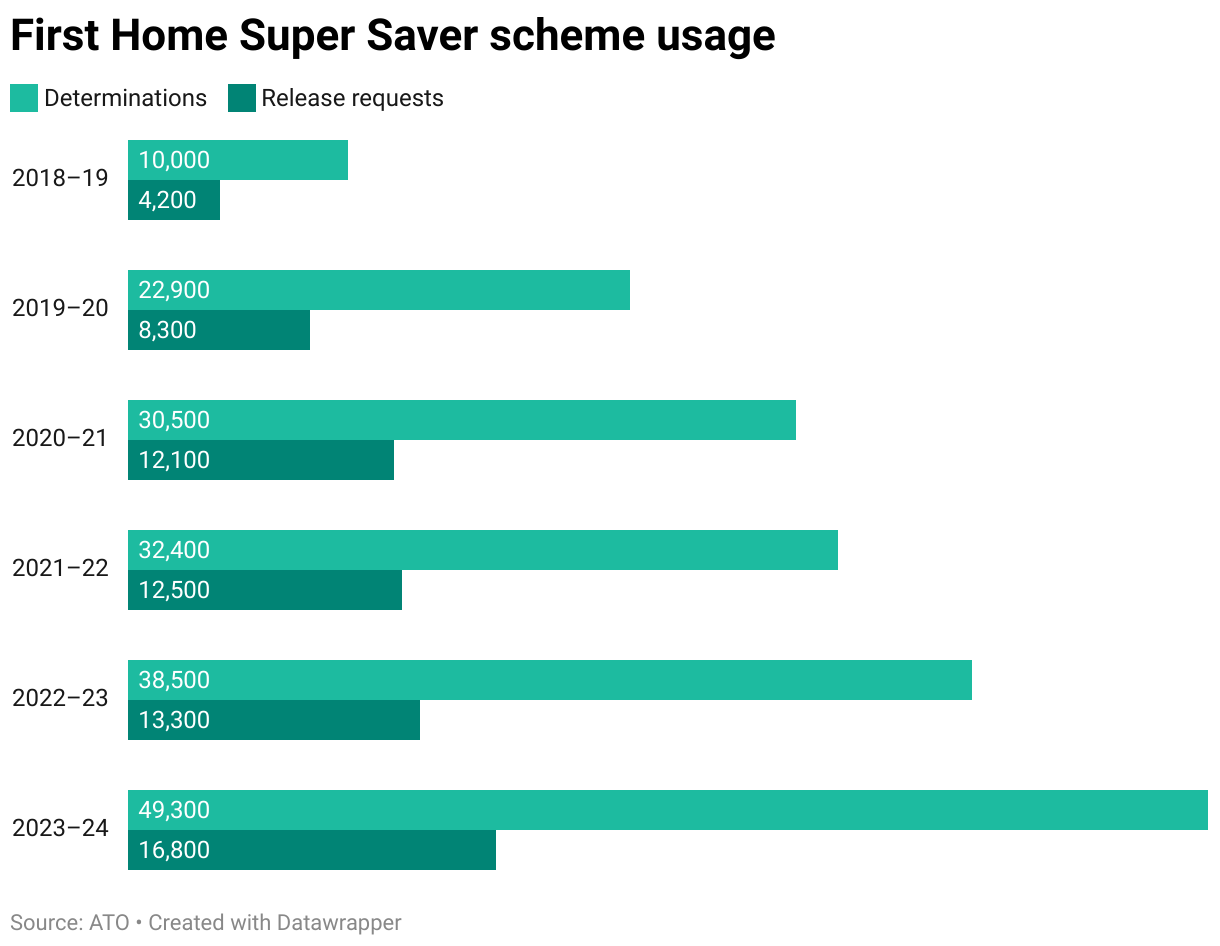
The use of the FHSS scheme has steadily grown since its introduction in 2017. According to ATO statistics, in 2018–19, there were 10,000 determinations and 4,200 release requests. By 2024–25, determinations had risen to 52,300, while release requests reached 18,300 – a more than fivefold increase in determinations and a fourfold increase in release requests over six years.
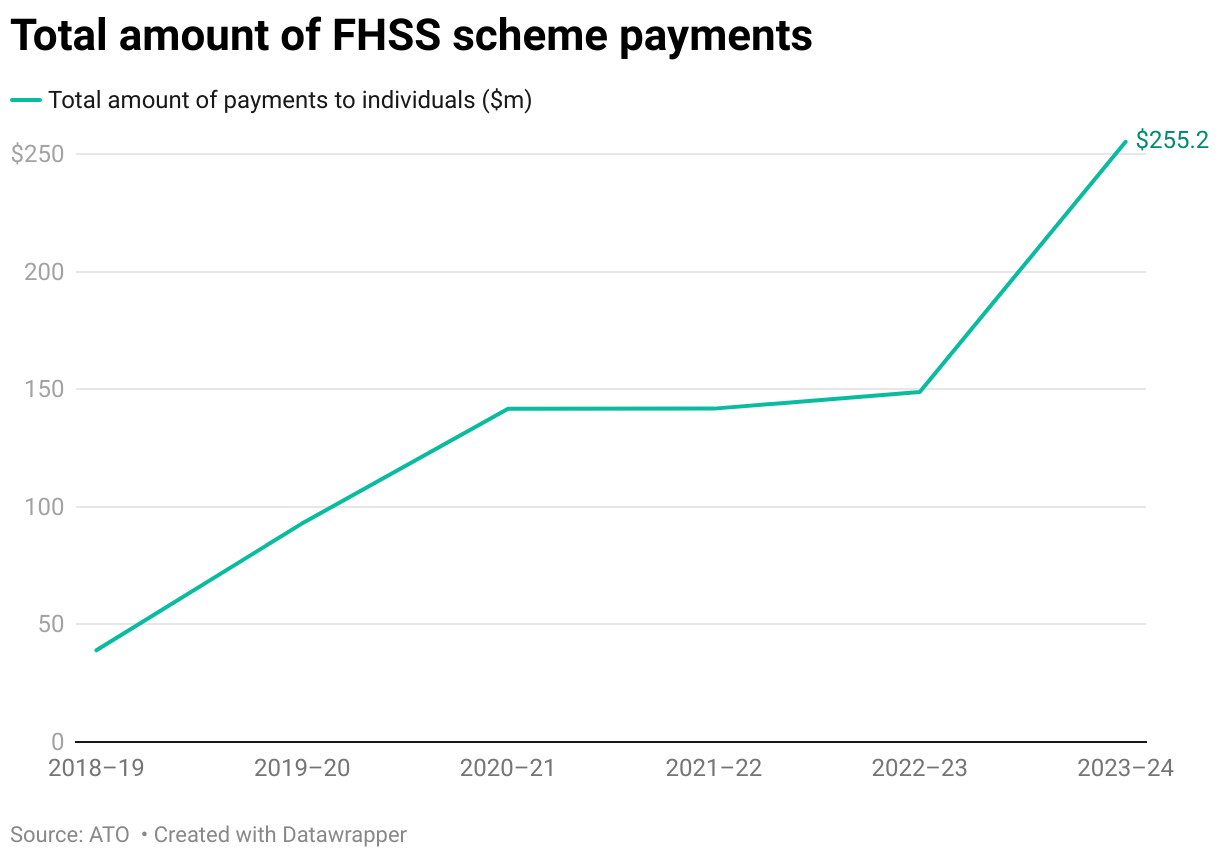
In this time, the total amount of payments to individuals under the scheme increased from $38.9 million in 2018–19 to $303.6 million in 2023–24. After a period of relative stagnation during the Covid years, payments jumped by almost 72% between the 2022–23 and 2023–24 financial years, and continue to rise.
How does the FHSS scheme work?
1. Make voluntary contributions
You make extra payments into your super fund. These can be either:
- Concessional (before-tax) contributions such as salary sacrifice.
- Non-concessional (after-tax) contributions paid from your take-home pay.
You can choose to use just one type of contribution or split your voluntary contributions between the two types.
Be aware, however, that standard employer contributions (such as the compulsory Super Guarantee) don’t count and can’t be accessed under the scheme.
2. Build your funds (and save on tax)
You can contribute for as long as you like, but only $15,000 per year and $50,000 in total is eligible under the scheme.
You can withdraw 85% of any concessional contributions, including eligible personal voluntary super contributions you have claimed a tax deduction for, and 100% of non-concessional contributions that you haven’t claimed a tax deduction for.
3. Apply for your FHSS determination and release
Before buying a property, you must apply to the ATO for an FHSS determination, which confirms the maximum amount you can withdraw. This must be done before signing the contract, or you’ll be ineligible to access the funds.
Once you have a determination, you can apply to release your contributions and associated earnings. The release request must be made either before or within 90 days of signing the contract.
After requesting a release, you have 12 months to sign the contract to buy or construct your home, which can be extended to 24 months if the ATO approves.
You can request multiple FHSS determinations but can only make one release request.
You must also notify the ATO within 28 days of signing or a flat 20% FHSS tax applies.
4. Receive your funds
Once approved, the ATO instructs your super fund to release the money, which it then transfers to you. Concessional contributions and earnings are taxed at your marginal rate with a 30% offset, while non-concessional contributions are tax-free.
How much can you save with the FHSS?
The main reason for using the FHSS scheme comes down to tax savings. Let’s look at an example to see how using the scheme could boost your first home deposit.
Say you’re earning $90,000 a year, and choose to put $10,000 of that each year towards saving for a home deposit.
- Outside super (regular savings account): taxed at your marginal rate of 32% (30% plus Medicare levy), leaving you with $6,800 saved that year.
- Inside super (FHSS scheme): taxed at just 15%, leaving you with $8,500, a $1,700 annual difference.
Here’s how that would accumulate over five years:
| Year | Cumulative contribution | Cumulative net saved outside super | Cumulative net saved with FHSS | Cumulative extra saved |
|---|---|---|---|---|
| 1 | $10,000 | $6,800 | $8,500 | $1,700 |
| 2 | $20,000 | $13,600 | $17,000 | $3,400 |
| 3 | $30,000 | $20,400 | $25,500 | $5,100 |
| 4 | $40,000 | $27,200 | $34,000 | $6,800 |
| 5 | $50,000 | $34,000 | $42,500 | $8,500 |
| Note: This example doesn’t include any interest or associated earnings, either in super or a regular savings account. | ||||
When it comes time to withdraw, your accessible FHSS amount will be taxed at your marginal tax rate but will also benefit from a 30% tax offset.
In this scenario, this is how the numbers would work out:
| Item | Calculation | Amount |
|---|---|---|
| Tax on withdrawal | 32% of $42,500 | $13,600 |
| Tax offset | 30% of $42,500 | $12,750 |
| Tax payable | $13,600 – $12,750 | $850 |
| Amount received | $42,500 – $850 | $41,650 |
Compared with saving outside super, where the same $50,000 in pre-tax income would leave $34,000 after tax, the FHSS strategy would provide $41,650 after withdrawal tax, an extra $7,650 towards a first home deposit.
On top of this, you can also withdraw the earnings on your FHSS scheme contributions. These are calculated using a fixed deemed rate, based on the shortfall interest charge (SIC), which is typically higher than the interest offered on even the best high interest savings accounts.
First Home Super Saver scheme eligibility
To participate in the FHSS scheme, you must:
- Be at least 18 years old (though you can make contributions before turning 18)
- Have never owned property in Australia, unless you previously lost it due to financial hardship such as divorce, natural disaster, bankruptcy or illness
- Have never previously used the FHSS scheme
- Plan to live in the property for at least six of the first 12 months of ownership, or from when it becomes occupiable
You don't need to be an Australian citizen, permanent resident or resident for tax purposes to use the FHSS scheme.
The property you purchase must also meet the scheme’s eligibility requirements. It must be one of the following:
- An existing house, apartment, townhouse or unit
- A newly built residential property
- Vacant land, provided you sign a contract to build a home on it within 12 months of your FHSS funds being released (or longer if approved by the ATO)
However, you cannot use FHSS funds to purchase or build a property for investment or commercial purposes, a houseboat, motorhome or any other property that cannot be used as a residence.
Pros and cons of the First Home Super Saver scheme
Pros
-
Save money on taxes
By making voluntary contributions to your super fund under the FHSS scheme, you reduce your taxable income, leaving more money for your home deposit.
-
Build your first home deposit faster
Tax savings and super contributions can help you grow your deposit more efficiently compared to regular savings accounts.
-
Grace period to purchase your home
After withdrawing FHSS funds, you have up to 12 months to buy your first home, extendable to 24 months on request.
-
Fixed, predictable earnings
The SIC rate is generally higher than standard savings account interest and is not impacted by market fluctuations.
Cons
-
Contribution limits
You can only contribute up to $15,000 per year and $50,000 in total under the FHSS scheme, which is unlikely to cover a full deposit.
-
Complex rules
The FHSS scheme can be complex, and you need to follow the process carefully, making sure all requirements are met.
-
Potential penalties
If you miss the deadlines for requesting funds or purchasing your property, you may face FHSS tax penalties.
-
Limited flexibility
If you change your mind about buying a home, your contributions generally must remain in your super until retirement or be withdrawn with additional tax applied.
FHSS scheme alternatives
The FHSS scheme is one of several government programs designed to help people get on the property ladder.
Others include:
-
5% Deposit Scheme
The 5% Deposit Scheme allows eligible first-time buyers to purchase a home with just a 5% deposit without paying lenders mortgage insurance (LMI). Instead, the government acts as guarantor for the remaining 15%. The scheme has unlimited places and no income cap, though property price caps apply by state.
-
Help to Buy Scheme
Launched in December 2025, the Help to Buy Scheme lets eligible buyers enter a shared equity arrangement with the government, contributing as little as 2% as a deposit. The government takes up to 40% equity in new builds or 30% in existing homes, reducing your loan size and eliminating LMI. Places are limited to 10,000 per year, with income caps of $100,000 for singles and $160,000 for joint applicants.
-
First Home Owner Grant (FHOG)
The FHOG is a one-off cash payment available in all states and territories except the ACT for eligible buyers of new or substantially renovated homes. Depending on where you live, the grant ranges from $10,000 to $50,000.
-
Stamp duty concessions
Most states and territories also offer stamp duty exemptions or concessions for first home buyers, which can save tens of thousands of dollars on top of any grants. Full exemptions are available in several states for properties under certain thresholds, such as up to $800,000 in NSW and $600,000 in Victoria.
Can these schemes be used together?
In most cases, yes. The FHSS scheme, 5% Deposit Scheme, Help to Buy Scheme and FHOG each operate independently, and eligible buyers can often combine multiple programs. However, each has its own eligibility conditions, including income limits and property price caps, so it’s worth confirming if you qualify before applying.
If you’re unsure, a mortgage broker can help you identify the best combination for your situation.
Is the First Home Super Saver scheme worth it for me?
If you’re set on trying to get into the property market, the FHSS is a handy scheme to help get you get there sooner. It can be most beneficial if:
- You’re committed to buying within the next few years: the tax savings alone can add thousands to your deposit without earning more or taking on additional risk, and your money is likely to grow faster inside super than in a standard savings account.
You’re a middle to higher income earner:
the scheme is most powerful where the gap between your marginal tax rate and the 15% super rate is largest. This means that the tax savings are most significant are for those earning between $45,000 and $250,000.However, if your income is below $45,000, your marginal rate is close to or below 15%, so the savings are negligible. Above $250,000, Division 293 tax applies, levying an additional 15% on concessional contributions and clawing back much of the tax advantage.
- You’re buying with a partner: each partner can contribute up to $50,000, meaning eligible couples may be able to withdraw up to $100,000.
- You want a low-effort, low-risk strategy: once salary sacrifice is set up, the process is largely automatic, with no need to manage investments or tolerate market volatility.
However, the scheme won’t suit everyone. If you’re not sure whether you’ll buy or not fully committed, think carefully before locking money away in super. If you decide not to buy, you’ll either leave the funds until retirement or withdraw them and pay a flat 20% tax on the released amount.