


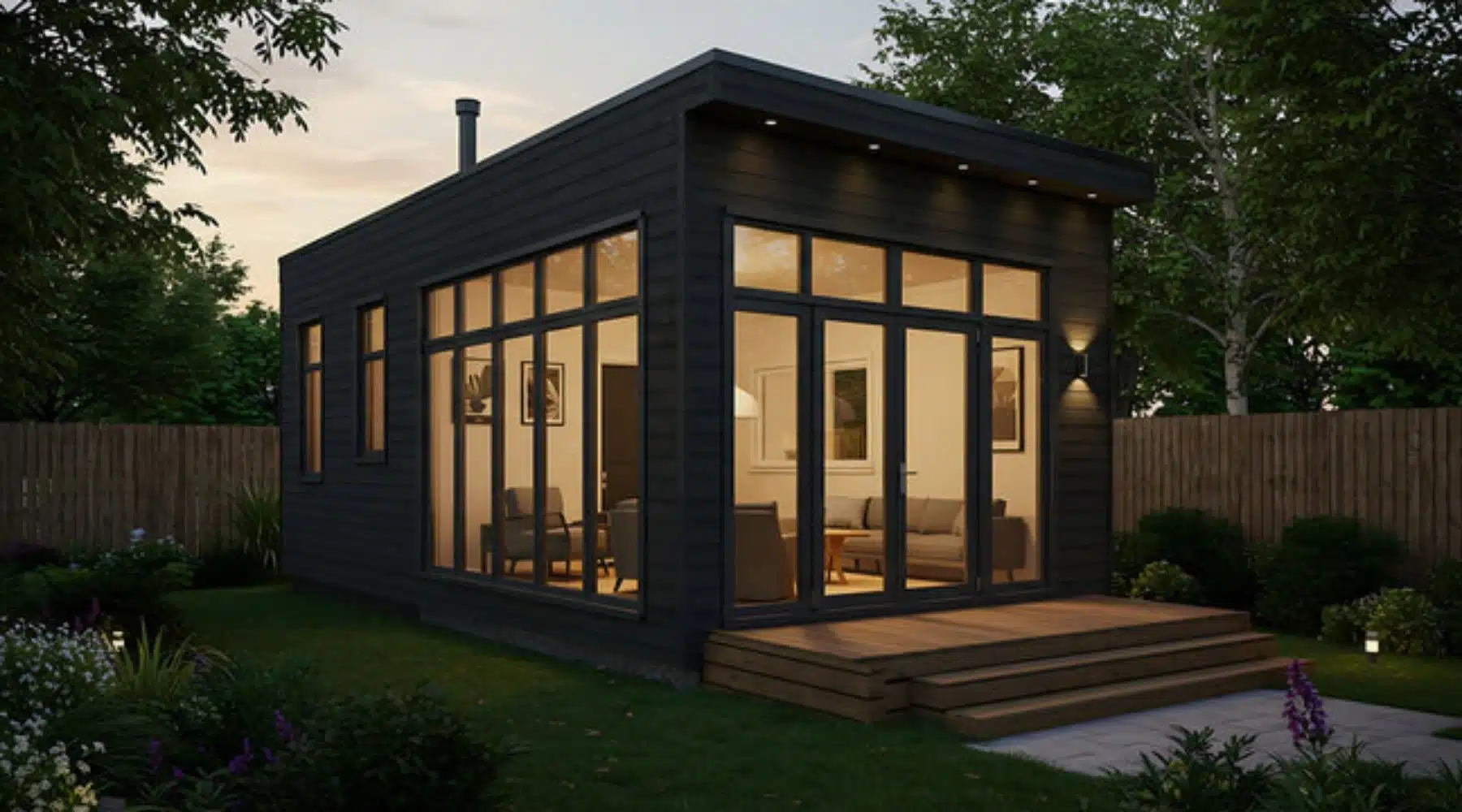
Granny flats are becoming a more popular way for homeowners to make better use of their property, whether that’s to create extra space for family or generate rental income. Housing Industry Association research found builders expected to construct around ten times more granny flats in 2026 than they did in 2022, reflecting growing demand for smaller, more flexible housing options.
If you’re considering adding one to your property, it helps to understand the costs involved and the finance options available to get your granny flat build off the ground.
What are my options for financing my granny flat?
There are two main ways to finance your granny flat build: adding the cost to your current home loan to cover the cost and applying for a construction loan.
Adding to your home loan using equity
Home equity is the difference between the value of your home and the amount you still owe on your mortgage. For example, an $800,000 home with a mortgage balance of $300,000 would have $500,000 in equity. Equity increases both by continuing to pay down your home loan and through its gradual increase in value.
Most lenders will allow you to borrow up to 80% of your property’s value, minus what you still owe, known as your usable equity. On the example above, 80% of $800,000 is $640,000, minus the $300,000 owing, giving you $340,000 in usable equity. You’ll typically need enough usable equity to cover at least 20% of the construction cost.
Equity can be accessed via a home loan top-up, internal or external refinance or through a line of credit facility. Topping up or refinancing your home loan essentially means you’re adding the cost of the granny flat to your mortgage. However, because of the nature of the construction process and its cost, topping up may not always be the most suitable option.
Taking out a construction loan
A construction loan is a finance option designed to cater to the different needs and timeline of a build.
Like other home loans, you’ll need to put down a deposit to secure the loan. However, you can use home equity from your current loan to cover this, avoiding the need to pay a deposit yourself. If you don’t have enough equity built up in your home, you’ll typically need to pay at least 20% in cash upfront to avoid lenders mortgage insurance (LMI).
Unlike a standard home loan, though, the loan funds are released in stages as building milestones are met.
- Initial deposit to builder: 5% of loan amount released
- Slab/base (foundations laid): 10% to 20%
- Frame (interior and exterior frame and walls): 20%
- Lock-up (roof, external walls): 20% to 40%
- Fit out (all plumbing and electrical fixtures and fittings): 20% to 30%
- Completion (finishing touches): 10%
Most lenders offer construction loans, but not all will approve one for a granny flat build, since granny flats differ from a standalone, sellable property. The good news is that plenty of lenders are comfortable financing them, so there are still solid options to choose from.
Why apply for a home loan with Savvy
Help throughout the process
You'll be matched with an experienced mortgage broker who'll handle all the hard work for you from start to finish.
Trusted lenders
With a panel of reputable mortgage lenders, you can rest assured you'll be comparing high-quality options with your broker.
Paperless quote process
You can fill out a simple online quote via our form without having to worry about sorting through heaps of paperwork.
Do you need council approval to finance a granny flat?
Yes, if your granny flat needs council approval to build, you’ll need to secure this before your lender will approve your construction loan.
Council approval requirements vary considerably between states and territories, and can depend on factors like your land size, zoning and the granny flat’s design, so it’s worth understanding what applies to you before you apply for finance.
Here’s how approval pathways generally work in each state and territory:
| State/territory | Typical approval needed for a granny flat |
|---|---|
| New South Wales | A granny flat may be approved through a Complying Development Certificate (CDC) if it meets the relevant standards, including a minimum 450m² lot in most cases. If it doesn’t qualify, you’ll generally need to lodge a Development Application (DA) with the council. |
| Victoria | A planning permit usually isn’t required for a small second dwelling up to 60m² on most residential and rural properties, although exceptions apply. A building permit is always required. |
| Queensland | Building approval is required for a new granny flat. Whether you also need development approval depends on the local council planning scheme and your property. |
| South Australia | Granny flats, known as ancillary accommodation, require development approval, which includes both planning and building approval. |
| Western Australia | A compliant ancillary dwelling will generally be exempt from development approval if it meets the R-Codes, including the 70m² maximum floor area. A building permit is still required. |
| Tasmania | Approval depends on the applicable planning scheme and property. The current state definition generally limits a secondary residence to 60m², although changes to increase this to 90m² are under assessment in 2026. |
| Australian Capital Territory | A granny flat, known as a secondary residence, must meet the Territory Plan requirements, including a maximum size of 90m². Whether a DA is required depends on whether the proposal meets the relevant exemption and development controls. |
| Northern Territory | In many cases, a compliant independent unit can be built without planning approval, but building approval is required. A development permit is needed where the proposal doesn’t meet the Planning Scheme requirements or is otherwise assessable. |
| These are general state and territory rules only. Zoning, overlays, lot size, setbacks and local council requirements can change the approval pathway for an individual property, so check the requirements that apply to your site before applying for finance. | |
Once the required approvals are in place, your lender will usually want to see the approved plans and other construction documents before progressing the loan. Having these ready can help avoid delays when you apply for finance.
How much does it cost to build a granny flat?
The cost of building a granny flat can vary from as little as $80,000 on the lower end to more than $200,000 for larger, more upmarket builds. However, there’s a wide range of factors that impact the cost of construction, including:
- The size of the granny flat: larger builds generally require more materials and labour.
- The layout and design: a simple studio will usually cost less than a multi-room design with a separate kitchen and bathroom.
- Site conditions and access: sloping land, difficult soil or limited backyard access can make construction more expensive.
- Fixtures and finishes: kitchens, bathrooms, flooring and higher-end fittings can add considerably to the overall cost.
- Utility connections: connecting electricity, water, sewerage and other services can be a significant expense.
- Approvals and site preparation: planning, building approvals and any work needed to prepare the site should also be included in your budget.
Given how much these factors can shift your total cost, it’s worth getting a clear budget before applying for finance, so you can borrow the right amount from the start rather than needing to top up partway through the build.
- National approach to granny flats to unlock thousands of new homes - Housing Industry Association
- Secondary dwellings - NSW Government
- Small second homes - Victoria Department of Transport and Planning
- Secondary dwellings providing housing solutions - Queensland Government Department of State Development, Infrastructure and Planning
- Frequently Asked Questions - Government of South Australia Department for Housing and Urban Development
- Revised R-Codes now in effect - Western Australian Planning Commission
- Tasmanian Planning Scheme - Tasmanian Planning Commission
- Factsheet Navigating the planning system: Secondary residence - ACT Government Territory Planning Authority
- Building an independent unit - Northern Territory Government
- How Much Does a Granny Flat Cost? - hipages
- New planning rules secure granny flats for rental and boost design for new homes - PlanSA
- Rental expenses - Australian Taxation Office
- Property and capital gains tax - Australian Taxation Office
- Room to grow: Aussies turn to granny flats as renovation loans surge - NAB