

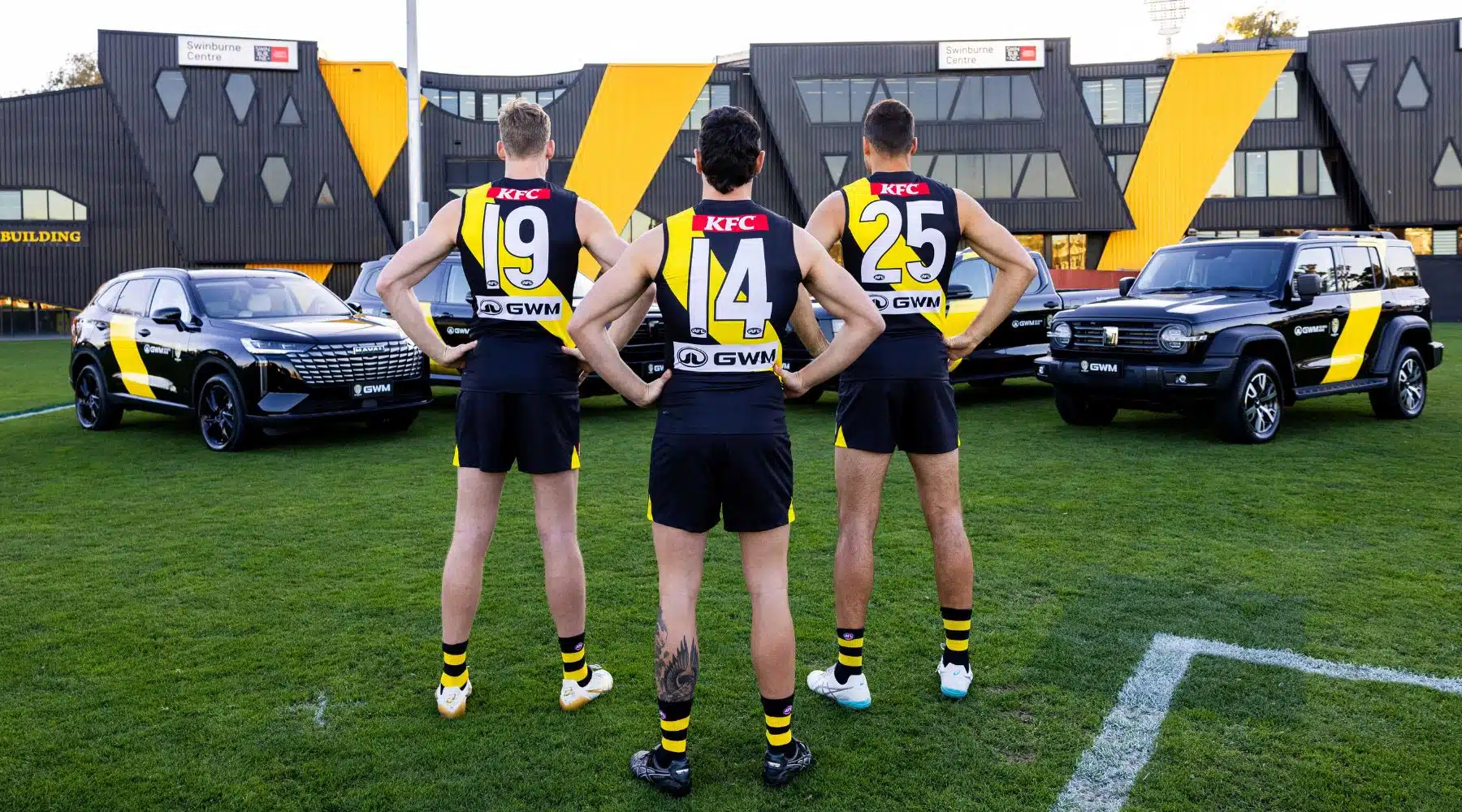

While the proper competition will be getting started on AFL and NRL fields in March, is there another battle happening right under our noses? As Chinese car brands continue to cut through in the Australian market, one simple way they’ve been able to do so is through corporate partnerships with some of the most-watched sports teams in the country. So, just how much of an impact does apparel sponsorship have when it comes to buying vehicles in Australia?
Chinese cars: from laughing stock to powerhouse
It’s safe to say that the public perception of Chinese vehicles has come a long way, even though many still have questions over their newfound domination. That wasn’t just from the general public, either; Tesla’s controversial CEO, Elon Musk, famously laughed at the prospect of BYD competing with his company on the EV front back in 2011. Nowadays, it’s the best-selling manufacturer of electric vehicles on the planet.
In Australia alone, three of the top ten best-selling manufacturers were Chinese-owned: GWM, BYD and MG. Contrast those numbers with their sales from ten years ago, and the difference is stark. Foton Light was the best-selling Chinese manufacturer according to VFACTS, tallying just 1,065 new sales across 2015. LDV racked up just 767, while Chery (201) and GWM (142) plumbed the depths.
Sport’s stranglehold on the Australian market
There’s little doubt that Australians love their sport. The most-watched TV program of 2025 was the NRL Grand Final, reaching up to 6.4 million viewers across its broadcast to edge out the AFL Grand Final (also 6.4 million viewers). The NRL’s State of Origin was also a ratings juggernaut, with the decider reaching 5.7 million viewers.
When you’re talking in those terms, it’s pretty clear to see why car manufacturers and other major brands are always clamouring to partner with professional teams and leagues, particularly the AFL and NRL. Whether that’s getting a logo on their playing kit, securing advertising space at home games or simply popping up across their socials, sports can offer near-unprecedented reach.
So, with all that in mind, there are two questions we’re looking to answer:
- Which manufacturers are popping up the most on AFL and NRL sporting kits?
- Are these sponsorships helping change the public perception of brands (namely, Chinese carmakers) and increasing their popularity?
Who’s popping up on AFL and NRL kits the most?
| Manufacturer | AFL/NRL clubs | Attendance: apparel sponsor | Attendance: non-apparel sponsor | Total attendance |
|---|---|---|---|---|
| Toyota | Adelaide, Western Bulldogs; Canberra, Cronulla, North Queensland | 1,852,026 | 1,201,850 | 3,053,876 |
| Hyundai | Brisbane Lions, Carlton | 2,026,253 | N/A | 2,026,253 |
| GWM | Richmond; New Zealand | 1,541,409 | N/A | 1,541,409 |
| KGM | Collingwood | N/A | 1,427,386 | 1,427,386 |
| Ford | Geelong; Penrith | 952,282 | 465,292 | 1,417,574 |
| MG | Port Adelaide; South Sydney | 1,309,353 | N/A | 1,309,353 |
| Nissan | Hawthorn | 1,046,059 | N/A | 1,046,059 |
| Volvo | Manly, Penrith | N/A | 868,632 | 868,632 |
| Polestar | Melbourne Demons | N/A | 846,886 | 846,886 |
| Volkswagen | Sydney Swans | 825,110 | N/A | 825,110 |
| Kia | Brisbane Broncos | 804,265 | N/A | 804,265 |
| Chery | St Kilda | 760,320 | N/A | 760,320 |
| Mazda | North Melbourne | 726,543 | N/A | 726,543 |
| Geely | Canterbury-Bankstown | 657,774 | N/A | 657,774 |
| BYD | Sydney Roosters | 566,685 | N/A | 566,685 |
| Subaru | Parramatta | N/A | 532,082 | 532,082 |
| Suzuki | Melbourne Storm | 496,653 | N/A | 496,653 |
| JAC Motors | St. George Illawarra | 436,932 | N/A | 436,932 |
| Figures don’t include sponsorships from non-manufacturer dealerships. | ||||
Perhaps unsurprisingly, Japanese manufacturing giant Toyota have secured the most apparel sponsorships across the AFL and NRL in 2026, with three teams sporting their logo: the Adelaide Crows in the AFL and the Canberra Raiders and North Queensland Cowboys in the NRL. The combined attendance for matches featuring these teams totalled 1.85 million across last year.
That’s on top of non-apparel partnerships with the Western Bulldogs and Cronulla-Sutherland Sharks and a major partnership with the AFL itself. Bundle these clubs in with their ad space and appearance on other team merchandise and the number rises to 3.05 million sets of in-stadium eyes. In reality, that number would be countless more, given its league-wide sponsorship.
Hyundai did well out of its two AFL apparel sponsorships, the Brisbane Lions and Carlton Blues, with a combined attendance of 2.03 million, while Hawthorn attracted 1.05 million fans to their games in 2025, which will delight Nissan.
The Chinese carmakers getting attention at AFL and NRL games
GWM saw the highest combined attendance from its apparel sponsorships, with the Richmond Tigers and New Zealand Warriors racking up 1.54 million throughout their seasons. 1.30 million saw MG adorning the playing kits of the Port Adelaide Power and South Sydney Rabbitohs.
Chery (760,320), Geely (657,774), BYD (566,685) and JAC Motors (436,932) racked up decent numbers through partnerships with the St Kilda Saints, Canterbury-Bankstown Bulldogs, Sydney Roosters and St. George Illawarra Dragons, respectively.
Sports team sponsorships vs sales
Toyota’s status as Australia’s most visible car translated to market domination as usual, accounting for just under one out of every five new vehicles sold in 2025. What’s most interesting to look at here, though, is Chinese manufacturers like GWM, Chery and BYD, whose new car sales figures grew by 23.4%, 176.8% and 156.2%, respectively, compared to 2024. We can see from the table above that all had strong exposure for both fans watching in person and on their couches.
Geely and JAC Motors took their first steps into the Aussie market in 2025 and, although they didn’t register crazy numbers, they’re undoubtedly building name recognition as competitively priced manufacturers in an increasingly cutthroat business.
Circling back to where we started, there’s no disputing that Chinese manufacturers are seen as being more credible these days than ten, or even five, years ago. The proof of that is in the sales: the number of new Chinese-owned cars sold in Australia rose from one out of every eight in 2024 to one out of every six in 2025.
Of course, it’d be disingenuous to attribute the growth of these carmakers solely to their AFL and NRL sponsorships, but there’s no doubt that putting your name in front of hundreds of thousands, and in some cases millions, of Australians every week is an effective way to promote your brand.
Crucially, though, sponsoring elite sporting organisations like these will boost the credibility of these brands by association. In an article for Lindenwood University in the US, Alexandra Bardon wrote that in establishing these partnerships, “brands can communicate reliability, build relationships with consumers, and ultimately enhance loyalty”. That’s exactly what we’re seeing in the rehabilitation of China’s car-making image in Australia.
- Elon Musk once mocked China’s BYD. Now it’s running circles around Tesla - CNN Business
- China's BYD overtakes Tesla as world's top EV seller - BBC
- NRL grand final sets TV ratings record and eclipses AFL for first time in decade - The Guardian
- TV Ratings Wednesday 9 July 2025: Origin III most-watched program of the year, breaks all time BVOD record - Mediaweek
- Impact of Sponsorship and Endorsements in Sport Management - Lindenwood University